Heat Shrink Tubing: 2:1, 3:1 or 4:1, and How to Size It
The number on a heat shrink pack is the size before you heat it. The ratio tells you the size after. Get both right and the tube slides on easily and still closes tight.
Why a splice needs covering
A crimped or soldered splice is bare metal. Left that way, it can touch the frame, the next wire or a wet surface. Tape was the old answer. It unwinds in heat and leaves a sticky mess.
The workplace rule does not name a product. It asks for a result.
All splices and joints and the free ends of conductors shall be covered with an insulation equivalent to that of the conductors or with an insulating device identified for the purpose.
U.S. Occupational Safety and Health Administration, 29 CFR 1910.303, General requirements (electrical, workplaces). Read 28 September 2026.
Heat shrink tubing is one of the insulating devices that rule allows for, and the easiest to get right: slide it on before the joint is made, move it over the joint, heat it until it closes.
- Heat Shrink
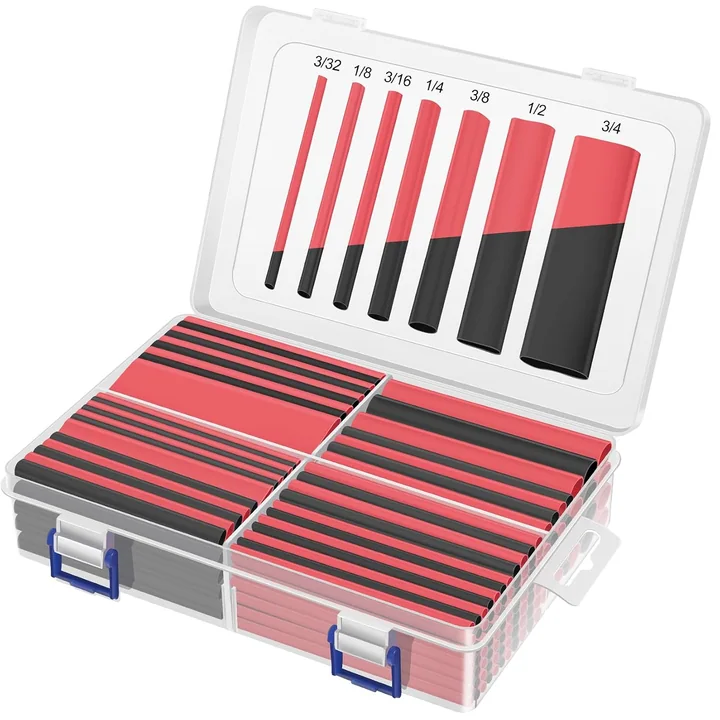
Black & Red 3:1 Heat Shrink Tubing
3:1 glue-lined tubing in black and red, for marking positive and negative.$9.29 to $179.99per pack, by sizefrom $0.74 per foot
What the ratio means
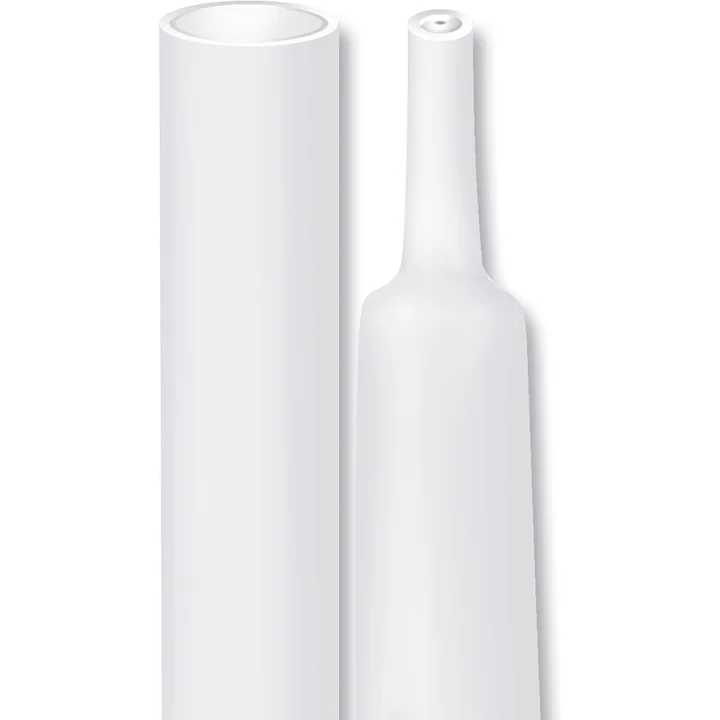
A 2:1 tube shrinks to half the size on the pack. A 3:1 tube shrinks to a third, a 4:1 tube to a quarter. So a 3/8 in tube closes to about 3/16 in at 2:1 and to 1/8 in at 3:1.
A higher ratio does one job better: it lets the tube pass over something wide and still close on something thin. A splice with a butt connector in the middle, a cable with a plug on the end, a wire going into a lug barrel. For a plain wire, 2:1 is enough.
- Heat Shrink
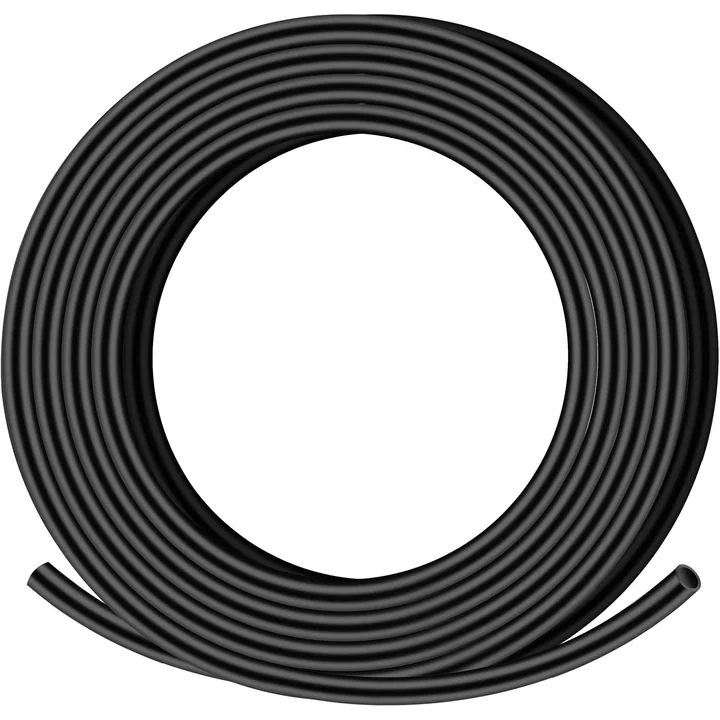
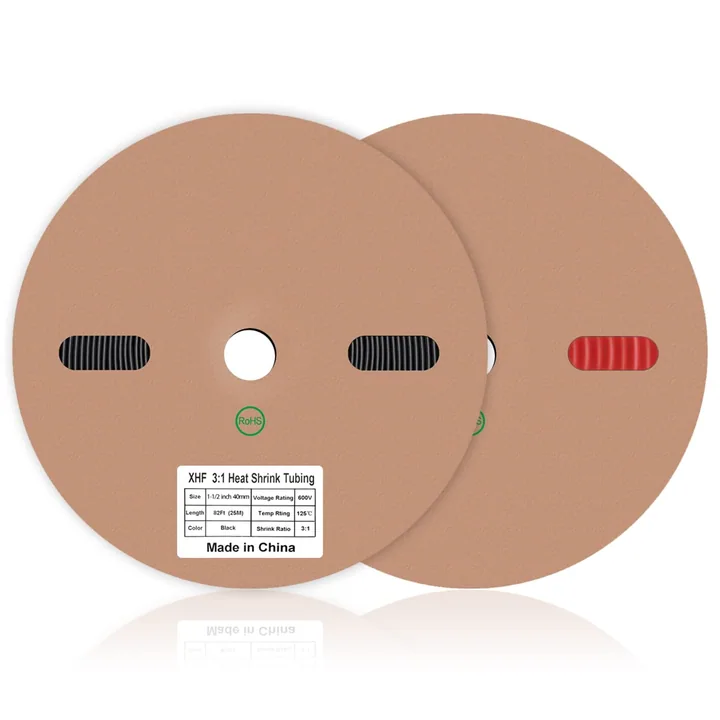
3:1 Heat Shrink Tubing Bulk Rolls, 55 and 82 ft
3:1 glue-lined tubing on 55 and 82 ft rolls for shops and big jobs.$17.99 to $59.99per pack, by sizefrom $0.33 per foot
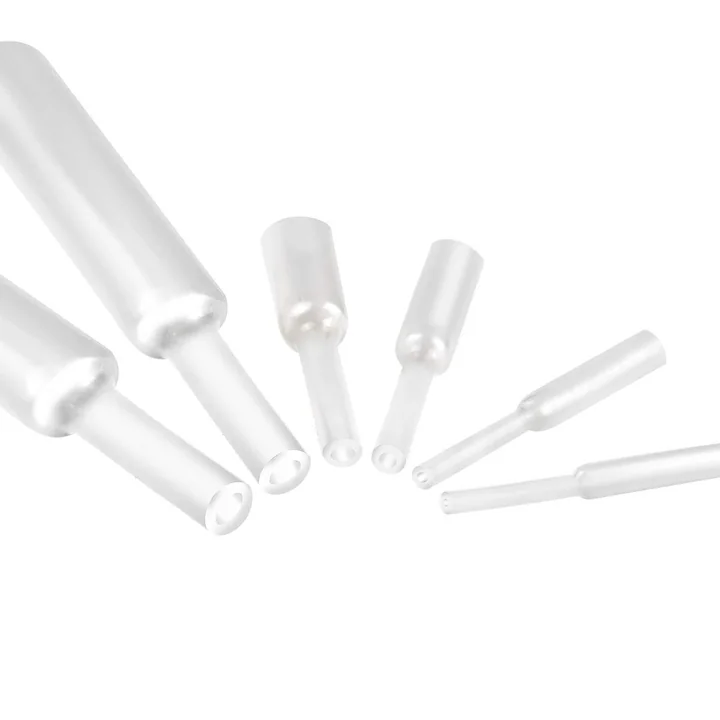
Sizing: over the widest part, under the thinnest
Measure two things. The widest point the tube must slide over, and the thinnest point it must close on. The tube's size before shrinking has to be larger than the first. Its size after shrinking has to be smaller than the second.
Leave some room at both ends. A tube that only just slides over a connector will split at that spot, and a tube that only just reaches the wire will not grip.
The table lists the sizes we make with the diameter after shrinking, worked out from the ratio.
| Size | Ratio | Shrinks to |
|---|---|---|
| 1/16 in | 2:1 | 1/32 in |
| 3/32 in | 3:1 | 1/32 in |
| 1/8 in | 3:1 | 3/64 in |
| 3/16 in | 3:1 | 1/16 in |
| 1/4 in | 3:1 | 5/64 in |
| 3/8 in | 3:1 | 1/8 in |
| 1/2 in | 3:1 | 11/64 in |
| 3/4 in | 2:1 | 3/8 in |
| 1 in | 2:1 | 1/2 in |
| 1-1/4 in | 2:1 | 5/8 in |
| 1-1/2 in | 2:1 | 3/4 in |
| 2 in | 2:1 | 1 in |
Glue-lined or plain
Dual-wall tubing has a second layer inside, a hot-melt glue. As the outer tube shrinks, the glue melts and fills the gaps around the wire. That is what keeps water out of a splice on a boat, a trailer or a garden light.
Plain single-wall tubing does not seal. It insulates, bundles and marks, and it stays flexible afterwards. Glue-lined tubing is stiff once it cools, which matters on a joint that bends.
Our 3:1 and 4:1 tubing is glue-lined. Our 2:1 tubing is plain.
Heating it right
A heat gun on a low setting is the right tool. Start in the middle and work to the ends, so air is pushed out rather than trapped. Glue-lined tubing is done when a thin bead of glue shows at both ends.
A lighter works on thin tubing in a pinch, but it chars the surface before the inside is warm, and on a large tube it scorches one side while the other is still loose.
- Cut the tube a little longer than the bare metal, about a quarter inch past each end.
- Slide it on before you crimp or solder.
- Heat from the middle out, turning the joint.
- Stop when the tube is tight and, for glue-lined tube, glue shows at the ends.
Where our numbers stop
Shrink ratios are the maker's figures for free recovery, with nothing inside the tube. Wall thickness after shrinking is not published for every size, and a column of guesses would be worse than none. When a joint has to meet a written standard, check that standard's requirements, not only our table.